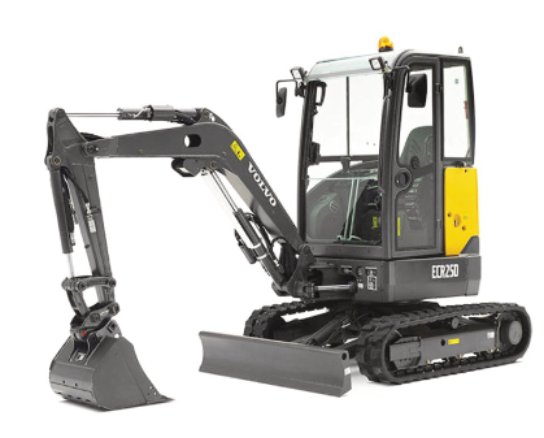
Mini excavators 2–3 t
Data: manufacturers and Bobcat's comparison tests. Does your experience say otherwise? Tell us ↓
| Parameter | Bobcat E26 | Volvo ECR25D |
|---|---|---|
| Capacity and weight | ||
| Operating weight, standard / heavy configuration kg | 2,608 / — | 2,490 / 2,680 |
| Working range | ||
| Digging depth, standard / long arm mm | 2,568 / — | 2,460 / 2,760 |
| Dump height, standard / long arm mm | 2,845 / — | 2,780 / 2,960 |
| Reach at ground level, standard / long arm mm | 4,413 / — | 4,310 / 4,600 |
| Forces | ||
| Bucket breakout force kN | 23.7 | 22.3 |
| Arm breakout force, standard / long arm kN | 15.7 / — | 17.7 / 14.9 |
| Dimensions | ||
| Max. tail overhang, standard / heavy counterweight mm | 70 / — | 0 / 75 |
| Undercarriage width mm | 1,500 | 1,500 |
| Overall track length mm | 1,965 | 1,906 |
| Track width mm | 250 | 250 |
| Overall height mm | 2,438 | 2,535 |
| Engine | ||
| Engine | Kubota D1105 | Volvo 1.1A |
| Engine power kW | 15.4 | 15.6 |
| Hydraulics | ||
| Hydraulic pumps | 1 gear pump + 2 variable piston pumps | variable piston pump with load sensing |
| Pump capacity l/min | 87 | 58 |
| Auxiliary flow l/min | 50 | 50 |
| Travel and slew | ||
| Travel speed low / high km/h | 2.5 / 4.3 | 2.4 / 4.5 |
| Boom swing left / right ° | 60 / 60 | 72 / 56 |
The table combines manufacturers' data and measurements from Bobcat's comparison tests (06-2020).
This comparison dates from 06-2020. A newer version of either machine may be on sale now, with different figures.
The E26 comes in one configuration: standard arm and standard counterweight. For a long arm or heavy counterweight the Bobcat E27z is the configurable model. The E26 limits boom swing to 60° so that the bucket cannot reach the cab. Volvo's only zero-tail machine in the 2–3 t class is the ECR25D, positioned between the E26 and E27z.
— means the manufacturer does not publish this figure.
On a platform 1.5 m high the E26 stands at 3.94 m, the ECR25D at 4.04 m — above the EU limit for road vehicles of 4.0 m.
Calculation: 1,500 + 2,438 = 3,938 mm; 1,500 + 2,535 = 4,035 mm
The E26 battery is reachable directly. On the ECR25D a tool is needed to open the side panel first, and the starter cannot be reached directly for a field replacement.
Rear cover, side cover and right-hand channel are steel on the E26 and plastic on the ECR25D.
The E26's blade cylinder hoses are two-piece and replaced in sections; the ECR25D's are one piece.
Measurements and notes come from Bobcat's comparison tests (06-2020), in which both machines did the same jobs. These figures are not in the manufacturers' brochures. “Operator's opinion” is the personal impression of the operator who worked in the test: it is subjective, and your experience may differ.
Operator's opinionsubjectiveThe machine stayed stable at full lift.
Operator's opinionsubjectiveThe lift capacity felt lower.
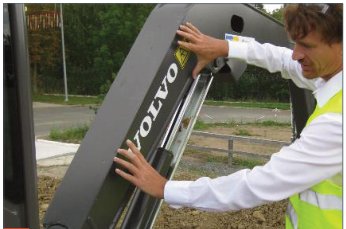
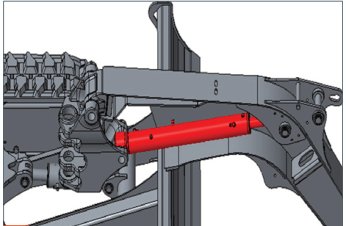
What it affects: In rental and demolition work a cylinder in front of the boom and its safety valve are exposed to knocks.
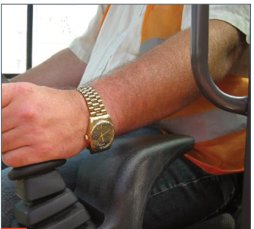
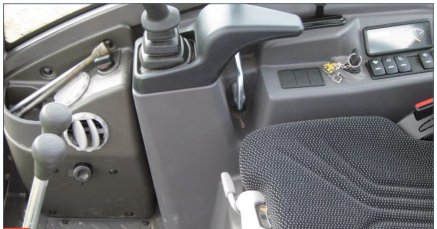
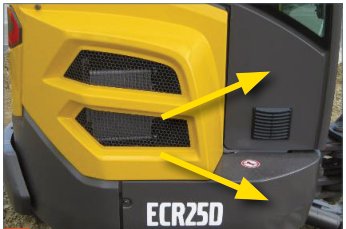
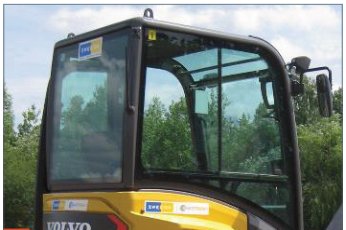
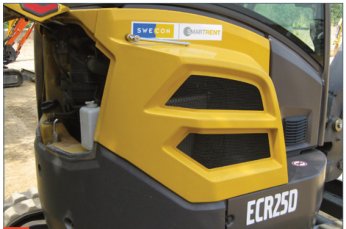
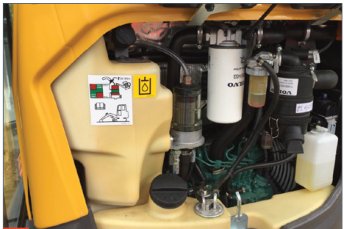
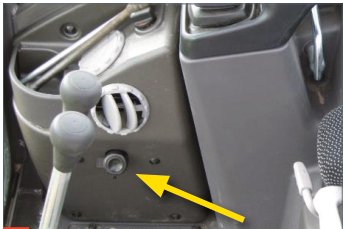
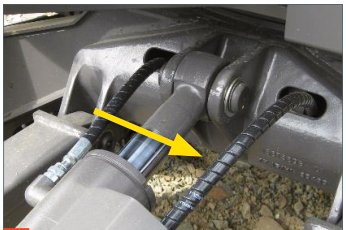
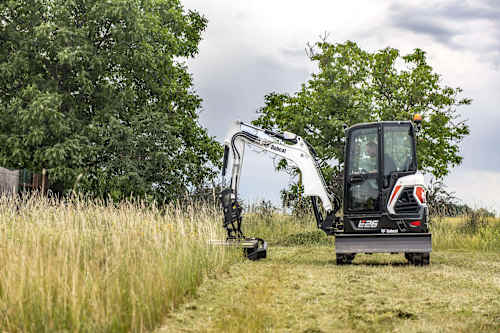
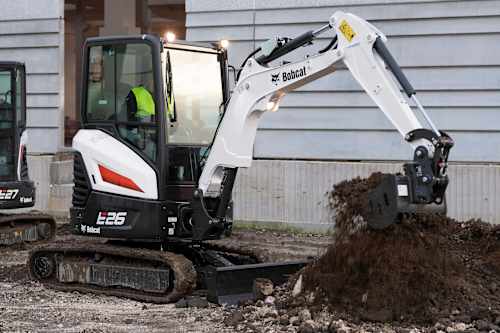
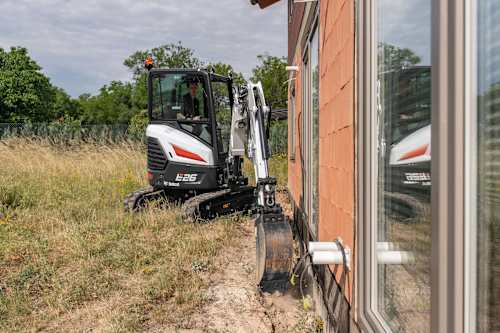
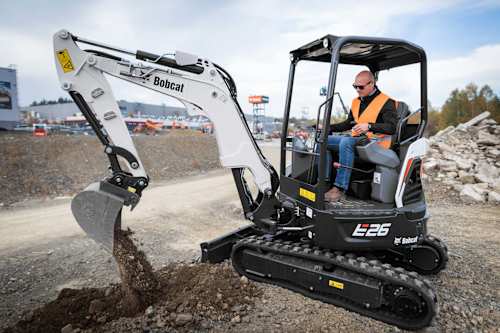
Photos: Bobcat comparison tests. Volvo ECR25D overview photo: Volvo.
Data checked 25.09.2026. Manufacturers may change their data; figures for a specific machine depend on its configuration.




Ehitajate tee 107A
13514 Tallinn Eesti
 +372 6 511 330
+372 50 27 368
+372 6 511 330
+372 50 27 368
 bobcat@bobcat.ee