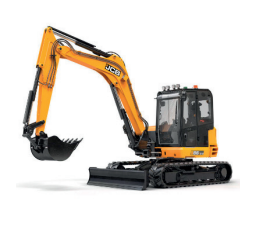
Excavators 8–9 t
Data: manufacturers and Bobcat's comparison tests. Does your experience say otherwise? Tell us ↓
| Parameter | Bobcat E88 | JCB 86C-2 |
|---|---|---|
| Capacity and weight | ||
| Operating weight kg | 8,919 (SAE J732, with counterweight) | 8,600 (ISO 6016, standard dipper) |
| Additional counterweight kg | +407 (option) | — |
| Ground pressure, rubber tracks kPa | 39.2 | 40.2 |
| Engine | ||
| Engine | Bobcat D24, 2.4 L, Stage V | Kohler KDI 2504 TCR, 2.5 L, Stage V |
| Net power kW | 48.5 | 45.4 |
| Hydraulics | ||
| Pump capacity l/min | 149 | 158.4 |
| Auxiliary flow (max.) l/min | 95 | 100 |
| Dimensions | ||
| Overall width mm | 2,200 | 2,300 |
| Height over cab mm | 2,550 | 2,706 |
| Track width mm | 450 | 450 |
| Track length on ground mm | 2,311 | 2,325 |
| Undercarriage length mm | 2,896 | 2,950 |
| Working range | ||
| Digging depth mm | 4,519 / 4,859 | 3,931 / 4,381 / 4,531 |
| Dump height mm | 4,537 / 4,765 | 5,061 / 5,395 / 5,506 |
| Reach at ground level mm | 7,087 / 7,418 | 6,635 / 7,075 / 7,225 |
| Forces | ||
| Bucket breakout force kN | 55.6 | 57.1 |
| Arm breakout force kN | 39.1 / 35.3 | 49.9 / 42.3 / 40.3 |
| Travel and slew | ||
| Boom swing left / right ° | 64 / 61 | 55 / 60 |
| Slew speed rpm | 9 | 10 |
| Travel speed low / high km/h | 2.5 / 4.4 | 2.5 / 5.0 |
Table: manufacturers' published data. E88: standard / long arm. 86C-2: dipper 1,650 / 2,100 / 2,250 mm.
Operating weights are measured to different standards (SAE J732 and ISO 6016) and with different equipment, so they are not directly comparable. JCB ground pressure converted from 0.41 kg/cm².
— means the manufacturer does not publish this figure.
Road vehicles in the EU may be 4.0 m high. On a platform 1.3 m above the road the E88 stands at 3.85 m, the 86C-2 at 4.01 m.
Calculation: 1,300 + 2,550 = 3,850 mm; 1,300 + 2,706 = 4,006 mm
With the long arm the E88 digs to 4,859 mm, 259 mm below the connection. The 86C-2 with its longest dipper reaches 4,531 mm, 69 mm short of it.
Calculation: 4,859 − 4,600 = 259 mm; 4,600 − 4,531 = 69 mm
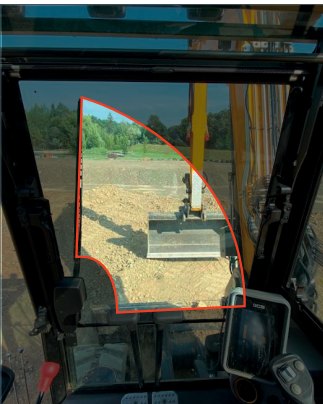
To dig parallel to the machine next to a wall, the boom is swung to the left. In Bobcat's test the bucket clears the left cab post from about 60° of boom swing. The E88 swings 64° to the left, the 86C-2 55°.
Calculation: 64° − 60° = 4° to spare; 55° < 60°
Measurements and notes come from Bobcat's comparison tests (07-2023), in which both machines did the same jobs. These figures are not in the manufacturers' brochures. “Operator's opinion” is the personal impression of the operator who worked in the test: it is subjective, and your experience may differ.
Operator's opinionsubjectiveThe machine rocked more, especially with the blade raised and with the long dipper.
What it affects: Counterweight, tail length and kingpost height decide how much the machine rocks when lifting over the side and working with a long dipper.
Operator's opinionsubjectiveThe joystick and armrest positions felt more comfortable.
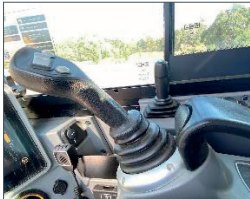
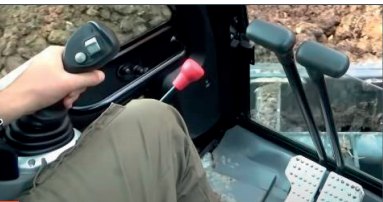
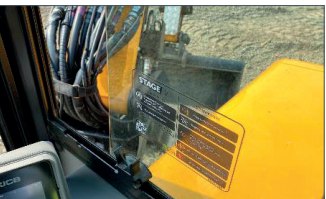
Operator's opinionsubjectiveMovements stayed smooth and predictable when several functions were combined.
Operator's opinionsubjectiveThe workgroup reacted more abruptly; precise positioning and combined movements needed more practice.
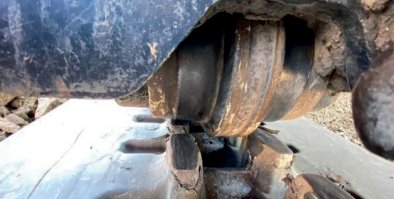
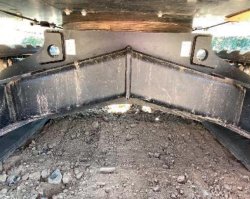
What it affects: Roller flanges keep the track in place: their number affects ride smoothness, side stability on a slope and which tracks can be fitted. The frame shape affects how rigid the undercarriage is under load.
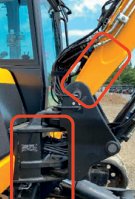
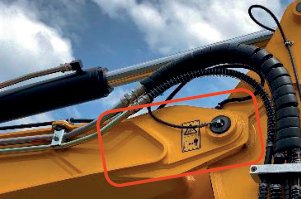
What it affects: A cast node is one piece; a welded node is several parts joined together — the difference is visible in the photos. It affects how the node copes with long-term alternating loads. A tilting cab affects how easily you reach the components underneath it.
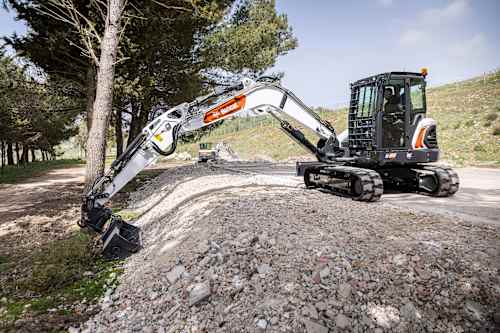
Photos: Bobcat comparison tests. JCB 86C-2 overview photo: JCB.



Data checked 25.09.2026. Manufacturers may change their data; figures for a specific machine depend on its configuration.




Ehitajate tee 107A
13514 Tallinn Eesti
 +372 6 511 330
+372 50 27 368
+372 6 511 330
+372 50 27 368
 bobcat@bobcat.ee